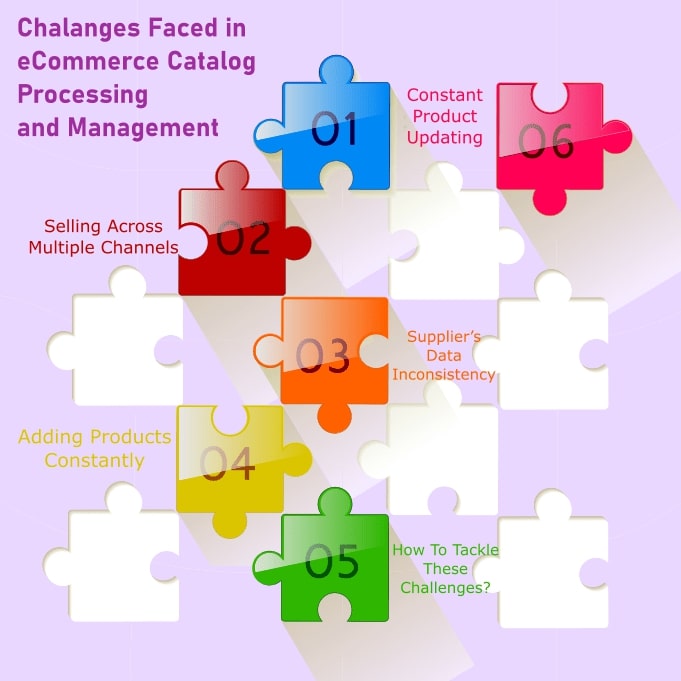
Catalog processing is the pivot around which your e-commerce growth revolves. If you own your own e-commerce store, managing and updating your product catalog is a very important yet time taking task for your business growth. You need to be on your toes while managing and updating your product data continuously as your sku’s need to placed across multiple eCommerce channels to place the products in front of a better crowd for more sales. As this task is cumbersome and time taking and it needs constant care, the online merchants tend to compromise with less than standard product information which negatively impacts their product sales.
Presenting you the list of the most common challenges faced by merchants in managing their product catalogs:
Constant Product updating
Many times, the sku’s need to be updated on a continuous basis for the ease of business and customers. This may include changes in price and other updations including features. This also includes new product addition to the online catalog. The continuous need of product management may lead to a mismatch of product information and other minute errors leading to big issues hampering your revenue.
Selling Across Multiple Channels
Apart from populating your product data on your eCommerce website, as a seller, you would be tempted to sell on eCommerce giants like Amazon, eBay, Sears, Alibaba, Houzz etc. Managing your product database on all these marketplaces can be very difficult to manage. Specially when giants like amazon have unique listing rules than others.
Therefore it becomes essential to get a good understanding of all the channels before listing and managing your products on each of them respectively. This means spending a lot of time and money to manage that in house. Otherwise, this often leads to doing the work in a hassle leading to errors and loss of revenue directly. From the customer’s point of view, a less maintained product catalog forces them to choose another seller.
Outsourcing product listings can save your time and resources and allow you to concentrate more on your core business operations like marketing and sales etc. Undertaking catalog processing services helps you to get industry experts at a low cost saving you money and also helping you better listings and product optimization.
Supplier’s Data inconsistency
Supplier data may be sometimes inconsistent with your requirements as suppliers tend to use many short forms. Therefore dealing with the supplier’s data is a tedious task many a time and it can cause you unnecessary delay.
Adding Products constantly
You may be required to constantly add more sku’s to your store to make it fully populated. This needs that your product catalog is managed smoothly and categorized properly. Not doing so would make your catalog look messy and it then becomes difficult to add more sku’s smoothly. Therefore, you may need a well-experienced team to add your products continuously to your catalog and also optimize your listings to make you sell more.
How To Tackle These Challenges?
Instead of keeping the product management tasks to yourself and facing the above issues, you can follow the shoes of other eCommerce sellers globally. That is you can outsource the product data management work for your eCommerce business and focus on other areas of your business. First, it will save you valuable time and money as outsourcing is cheap compared to in house person hiring and second, it saves you infrastructure cost needed for IT work, Third, because outsourcing companies have been working in this field hence you get expert’s services for your work who are constantly updated about the new changes/updating in various marketplaces rules. Hence it helps you multifold to outsource your product listing and data management task to a reliable service provider. This will keep your operational cost in check as you will get an offshore team working for you at a lower cost and doing all the tedious tasks with excellence for you.
Aumtec Solutions helps online sellers seamlessly process their product catalog through its fast, accurate, cost-effective eCommerce data and content services, including product listing services and managing their merchandise across multiple platforms, e-commerce catalog processing and data cleansing, product data enrichment and other data management tasks.
For More Information
If you need eCommerce catalog management and optimization, please drop an mail to us at manish@aumtecsolutions.com. We will be glad to talk about how our eCommerce catalog processing services can help your eCommerce business growth.
FAQ – Challenges Faced in Ecommerce Catalog Processing Management and Product Listing
1. What is ecommerce catalog processing management?
Ecommerce catalog processing management is the process of organizing, updating, maintaining, and optimizing product data such as titles, descriptions, images, prices, SKUs, categories, and inventory across ecommerce platforms and marketplaces.
2. What are the biggest challenges in ecommerce catalog management?
Common challenges include:
- Inconsistent product data
- Duplicate listings
- Manual data entry errors
- Inventory synchronization issues
- Managing multiple sales channels
- Poor product categorization
- SEO optimization difficulties
- Scaling large product catalogs
3. Why is accurate product listing important in ecommerce?
Accurate product listings improve customer trust, search visibility, product discoverability, conversion rates, and reduce return rates caused by misleading or incomplete information.
4. How do inconsistent product details affect ecommerce sales?
Inconsistent product information can confuse customers, reduce buyer confidence, increase cart abandonment, and negatively impact brand reputation and search rankings.
5. What problems occur when managing products across multiple marketplaces?
Different marketplaces like Amazon, eBay, Shopify, and Walmart have unique listing formats, category structures, and attribute requirements, making product synchronization and standardization difficult.
6. How does poor product categorization impact ecommerce websites?
Incorrect categorization makes products harder to find, weakens internal search functionality, hurts SEO performance, and creates a poor user experience.
7. Why is inventory synchronization challenging in ecommerce?
Managing inventory across multiple sales channels in real time is difficult because delayed updates can lead to overselling, stock inaccuracies, and customer dissatisfaction.
8. How can automation improve ecommerce catalog management?
Automation tools and AI-based systems help reduce manual errors, improve product categorization, automate metadata generation, synchronize inventory, and speed up bulk catalog updates.
9. What is a PIM system in ecommerce?
A Product Information Management (PIM) system centralizes product data management and helps businesses maintain consistent, accurate, and updated product information across all sales channels.
10. What are common product data quality issues?
Typical data quality problems include:
- Missing product attributes
- Incorrect specifications
- Duplicate products
- Spelling mistakes
- Inconsistent measurements
- Low-quality images
- Incomplete descriptions
11. Why is ecommerce catalog scalability difficult?
As product catalogs grow to thousands of SKUs, managing updates, attributes, categories, pricing, and inventory manually becomes inefficient and error-prone.
12. How can businesses overcome ecommerce catalog management challenges?
Businesses can improve catalog management by:
- Using automation tools
- Implementing PIM systems
- Standardizing product data
- Optimizing product categorization
- Regularly auditing listings
- Outsourcing catalog management services
- Using AI for product classification and validation